Quantum Solitons
Solitons, oscillons and Q-balls are often studied in classical field theory. However, the real world is not classical, and so these objects must be understood in quantum field theory. In quantum field theory, their basic properties change and new interactions are manifested. Our group is dedicated to understanding the fundamental interactions of these objects and their implications for cosmology and strong interactions.
Scattering can leave the kink unchanged (elastic), excite its localized shape mode (Stokes), or de-excite an already excited shape mode (anti-Stokes).
Evslin & Liu · (Anti-)Stokes Scattering on KinksTheory & simulation
We have developed a simple formalism for calculations involving quantum solitons. It has been used to calculate quantum corrections to soliton masses, form factors, scattering cross sections and decay rates of unstable excitations. Our goal is to understand topics such as oscillons in the early Universe and their role in baryogenesis, Q-ball superradiance, as well as magnetic monopoles in the QCD vacuum and their role in confinement, hadronization and nucleon structure.
Experiment
We are involved in planning the experiment Monopole And Nuclear Detector at Tibet Elevation (MANDATE). This is a Q-ball and magnetic monopole detector at the LHAASO cosmic ray observatory at 4400 m above sea level in Sichuan, China. It is currently in its pilot phase, but is funded for the next four years, which will include phase one of the experiment, which includes the deployment of the detector and two years of data taking. We aim to understand how Q-balls and magnetic monopoles are excited as they travel through the atmosphere and interact inside of the detector, and to calculate their resulting emitted radiation.
Motivation
Our central goal is to understand the QCD vacuum — in particular, the nature of and the role played by magnetic monopoles in that vacuum. Monopoles are believed to be essential to confinement and to the structure of the vacuum. However, classical QCD has no monopole solutions and, at low energies, QCD is strongly coupled. As a result, even the most basic characteristics of QCD monopoles are not understood.
A second driving question is the lifetime of the quantum oscillon, and what that lifetime implies for cosmology. Oscillons are long-lived, localized, oscillating field configurations that exist in many models, such as the φ³ and the φ⁴-double-well scalar models, axion models and even the electroweak model. They are attractor solutions that typically dominate the energy budget after violent events such as first order phase transitions, resonant reheating, soliton collisions and string-network collapse. Their lifetime determines whether they survive long enough to matter. For example, it determines the role played by oscillons in baryogenesis — whether these objects can generate the observed matter–antimatter asymmetry.
Methods
We treat classical and quantum solitons and oscillons both analytically and in full simulations. Because they are strongly nonperturbative, standard perturbative techniques break down. To handle the quantum case we use a new formalism called Linearized Soliton Perturbation Theory, a novel lightweight formalism that greatly simplifies previously impractical problems, in particular in situations with a single soliton or oscillon. Lecture notes from the Kraków school on quantum solitons are available on INSPIRE-HEP: Kraków Lectures on Quantum Solitons →
Results thus far
We have used Linearized Soliton Perturbation Theory to find one and two-loop corrections to kink masses and domain wall tensions. We have also used it to calculate form factors, binding energies of bound excitations, lifetimes of unstable excitations and various kink-meson and domain wall-meson elastic and inelastic scattering amplitudes.
Current research
We are currently computing the quantum oscillon lifetime within Linearized Soliton Perturbation Theory. We are also trying to quantize the Q-ball, to understand what classical superradiance will imply in the full quantum theory. We are also studying how oscillon collisions pass the sphaleron barrier and seed first order phase transitions.
Future directions
Going forward we plan to extend Linearized Soliton Perturbation Theory to a wider class of solitons — including supersymmetric kinks, vortices and monopoles, and to understand the implications for cosmology. We are also trying to understand Q-ball and monopole transport in the matter, focusing on the induced excitations of their internal degrees of freedom, their relaxation and the resulting radiation that will be observed at the MANDATE experiment. Our long-term goal is to understand the monopoles in Seiberg-Witten theory, Yang-Mills and QCD, and their role in the vacuum, and implications for hadron structure and hadronization.

Our team
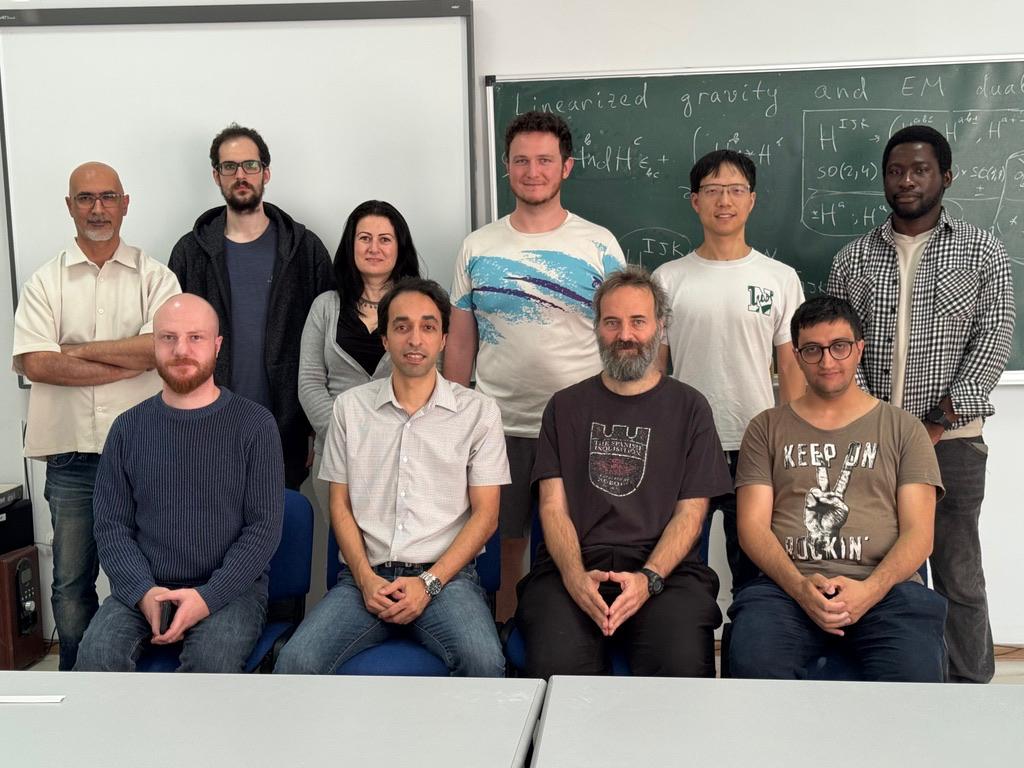
Researchers, postdocs, and students at Alikhanyan National Science Laboratory and our remote PIs.
Principal Investigators
Jarah Markar Evslin
PI 1 · Principal Investigator Institute of Modern PhysicsQuantum field theory, solitons.
Karapet Mkrtchyan (Կարապետ Մկրտչյան)
PI 2 · Principal Investigator Imperial College LondonHigher-spin theory, field theory.
Erik Khastyan
Local PI A. I. Alikhanyan National Science LaboratoryLocal Principal Investigator · contact: erik.khastyan@yerhpi.am
Group Leader
Danial Saadatmand
Group LeaderClassical/quantum solitons, nonlinear dynamics, and computational physics.
Danial's Group
Remote Laboratory
Aaron Conrad
Levon Hovhannisyan
Feshbach quasinormal modes of solitons.
Talks, reading courses, schools and workshops
Join us for our seminars and special events. All are welcome.
QFT
Weekly Online QFT Course (Thursdays at 11:30 AM, Yerevan time) — Coleman's Lecture Notes
Ongoing weekly online course working through Sidney Coleman's quantum field theory lecture notes. Open to all.
Online Course
8
Linearised Gravity as Edge Modes
Karapet Mkrtchyan · 3:00 PM · Fifth floor seminar room
7
Quantum Oscillons
Jarah Evslin · 2:00 PM · Third floor seminar room
Open positions
We are always looking for curious and motivated researchers. Join our team.
Student Positions (1–2 openings)
150,000 AMD / month pretaxOpenings for students interested in quantum solitons and related topics.
Student Theory / SimulationApplication requirements
- Cover letter
- Curriculum vitae (CV)
- Statement of research interests
- One recommendation letter
- Send the above materials to Jarah Evslin
Postdoctoral Positions
Starting at 300,000 AMD / month pretax · may rise to 400,000–800,000 AMD within the first yearFull-time postdoctoral research in quantum solitons, nonlinear dynamics, and related areas.
Postdoc Theory / SimulationApplication requirements
- Cover letter
- Curriculum vitae (CV)
- Statement of research interests
- Send the above materials to Jarah Evslin
- Arrange to have three recommendation letters sent
Applications are reviewed on a rolling basis. For inquiries, please contact us.
Get in touch
We welcome collaborations, inquiries, and visits. Reach out to us.